
The Eight-Figure Analyst?

Every other week I write an email discussing what I learn launching and growing Reboot Motion. If you would like to receive it directly in your inbox, subscribe below.
It’s hard to scroll through Twitter these days and be shocked. But when I saw this from Owen Phillips, I was.
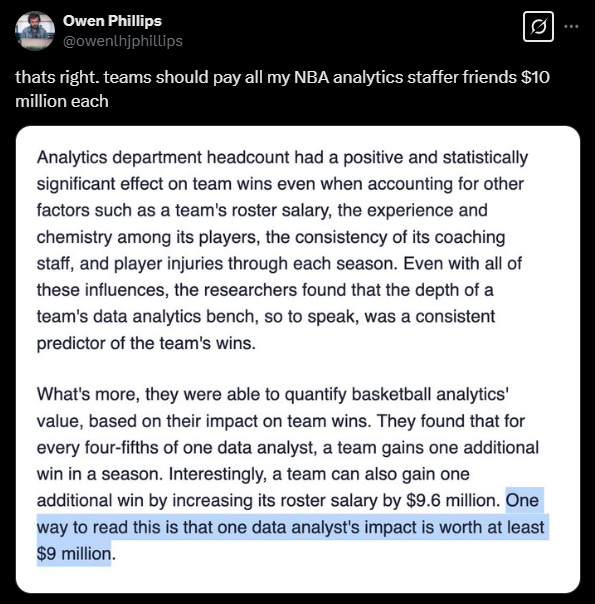
Owen’s screenshot is taken from an article detailing a new paper by Henry Wang, Arnab Sarker, and Anette Hosoi from MIT, titled The Effect of Basketball Analytics Investment on National Basketball Association (NBA) Team Performance.
Given Reboot Motion’s goal of bringing biomechanics to the NBA, I knew this was something I had to explore.
What They’re Not Arguing
Before diving into the takeaways, it’s worth noting what Wang, Sarker, and Hosoi are not trying to do…or at least what I believe they’re not trying to do.
They are not arguing NBA data analysts should go to their managers tomorrow asking for eight-figure pay packages.
Nor are they saying that sports can be run via spreadsheets or Python scripts.
Everyone knows great players and great coaches drive winning. MIT researchers aren’t writing papers analyzing their value because we are all already aware. It is unquestioned and therefore uninteresting to research.
In fact, when dissecting an analyst’s value, the authors start with curiosity around the recent increased investment in analytics. They aren’t pushing for more resources, but rather questioning if the current rise is justified, stating:
“Because significant financial resources are dedicated to basketball analytics across the association, understanding its ROI is crucial, and measuring a significant ROI would justify league-wide investment and potentially inform each team’s resource allocation process.”
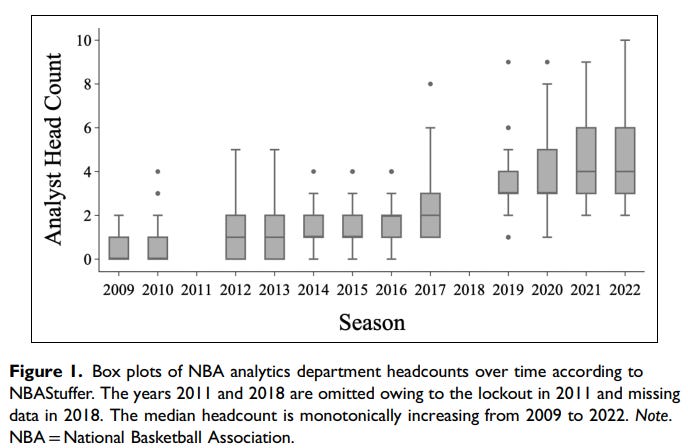
The Takeaways
When diving into their findings, the thing that sticks out the most is what many top executives already know: it all matters.
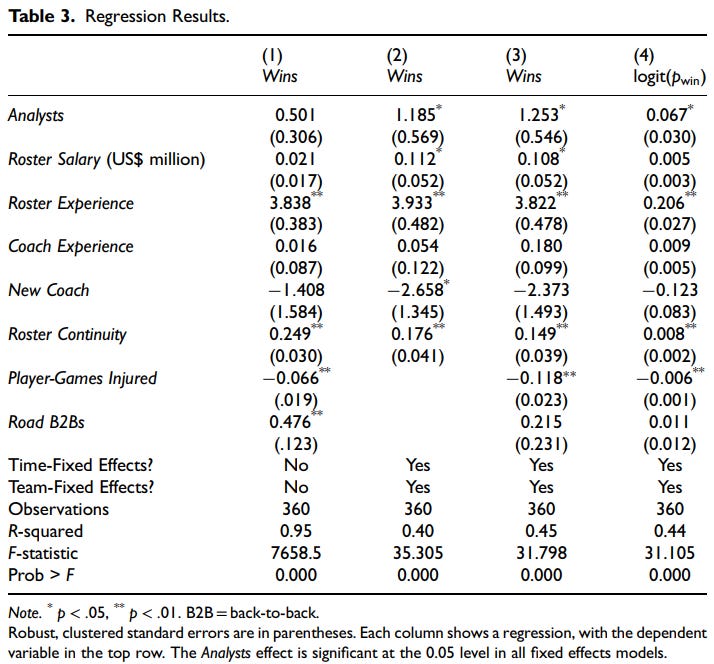
Putting the chart above in plain English, the authors found that “more technical analysts, more expensive players, more experienced personnel, and greater team chemistry all improve the odds of success as indicated by the positive regression coefficients.”
Still, the headline grabber isn’t unreasonable, as there are reasons to believe that, of all the variables, the number of analysts may yield the highest return on a per dollar basis.
Beyond the headline, there are broader lessons to take away…lessons 1) for everyone 2) for team executives and 3) for tech companies.
Lessons for Everyone
Innovation is undervalued. Valuing analytics is not about some magic windfall organizations get by putting numbers on things. Nor is it an argument to quantify everything or devalue things that can’t be measured (read: culture). Rather, organizations that value analytics are likely the same ones that value innovation. They are the same ones that are curious for the truth. They are the same ones that use numbers as a tool for thinking, and never as a way to replace thought.
Winning happens at the margins. The best path to winning is having the best players (duh!). Analytics should never be treated as an opposition to that belief, but rather as a complement. As the authors mentioned, on top of having great players, teams want a great coach, roster continuity, and a bit of injury luck.
However, since every team knows this, those looking for an edge have to hunt elsewhere.
Lessons for Team Execs
Investing in analytics is more than a hiring decision. This paper shows a direct relationship between 1) the size of an analytics staff and 2) winning, with a caveat that teams cannot simply hire more and more analysts in perpetuity:
“While [the] model provides interpretable effects within the observed range of the data, it is important to note that extrapolation beyond the range of 0 to 10 analysts would be invalid. For example, teams cannot achieve undefeated seasons simply by increasing analyst headcount or Roster Salary indefinitely.”
I see another limitation. It is not the hiring of analysts that impacts winning. It is listening to them. And it is the openness to searching for new, evidence-based ideas.
Today, it is very likely the teams with the largest R&D staffs also have leadership that is the most open to new ideas. For executives seeking an edge, bringing on new people (or new tech) is only step 1.Adaptability is key. The NBA landscape is changing. Not only is this happening with more and more available data, but also with added restrictions on roster flexibility and spending.
The teams that adapt by 1) listening to a wider range of ideas and 2) investing in technology, facilities, and more, will be the ones that find small, consistent advantages that compound over time.
Lessons for Tech Companies
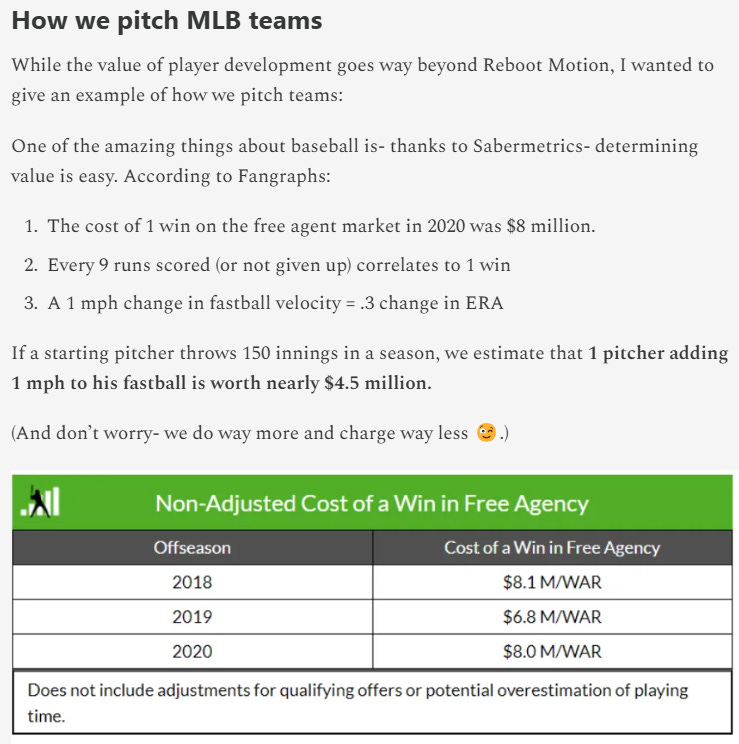
Know your value…but know it through your audience’s lens. When Reboot Motion started in MLB, we made a pitch similar to one you could make reading this paper.
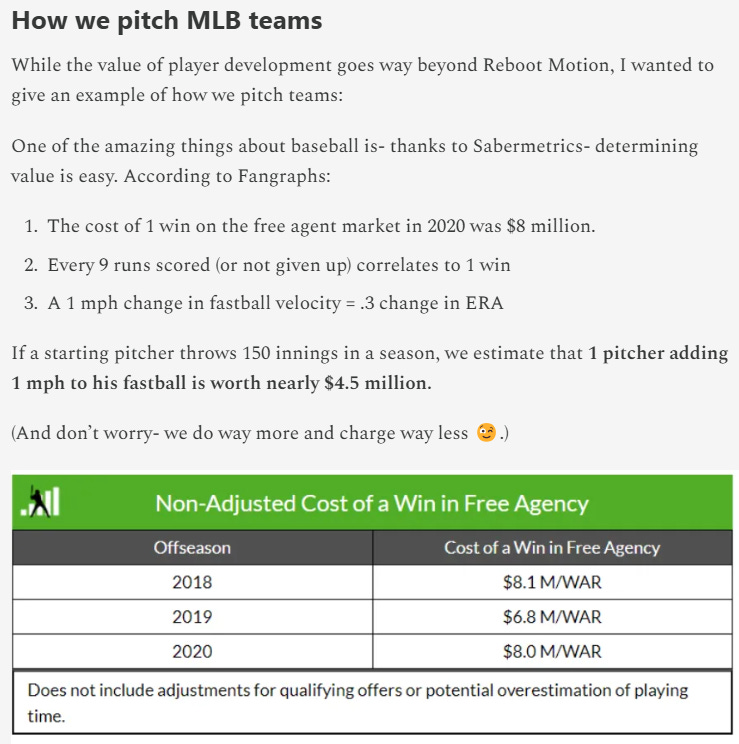
While I still believe what I wrote, and while I would think this way if I was a team owner or GM, it isn’t what gets the people we talk to excited. Regardless of the sport, the majority of our conversations are with AGMs, R&D Directors, and Performance Scientists.
These people don’t light up when talking about financial ROI’s. They care about1) winning and 2) excelling in their career. If you can draw the line from 1) your offering to 2) one of those two things, focus there.Be a guide. Front offices and coaches are judged by their decision-making. Are they drafting the right prospects? Are they setting up the right player development programs? Do they have the right strategy?
The strong correlation between analysts and winning in this paper is likely because analysts aid in decision making. For tech companies, that’s our job as well.
To Sum Up
Too often, any praise of analytics leads to a belief that something else is being de-valued. But as Wang, Sarker, and Hosoi show, it all matters.
The top organizations need to find value in talent acquisition, player development, coaching, analytics, tech, and anywhere else they think they can gain the slightest edge.
And tech companies need to understand things through the viewpoint of front offices- and realize they are a guide to great decision making.