
AI: What is it Good For
Absolutely something

Every other week I write an email discussing what I learn launching and growing Reboot Motion. If you would like to receive it directly in your inbox, subscribe below.
The tech theme of 2024 is AI- and sports tech is no different.
The use cases are expansive, with front offices improving their predictive analytics, sportsbooks setting better lines, and media companies changing how they talk to their audiences.
If you are a sports tech company in 2024, you’ve gotten the AI question.
And recently, when Reboot’s CEO Jimmy Buffi was on the Wharton Moneyball Podcast, we got the question:
Helping People Get on The Train
Jimmy starts his answer by referencing a metaphor we like- the biomechanics train.
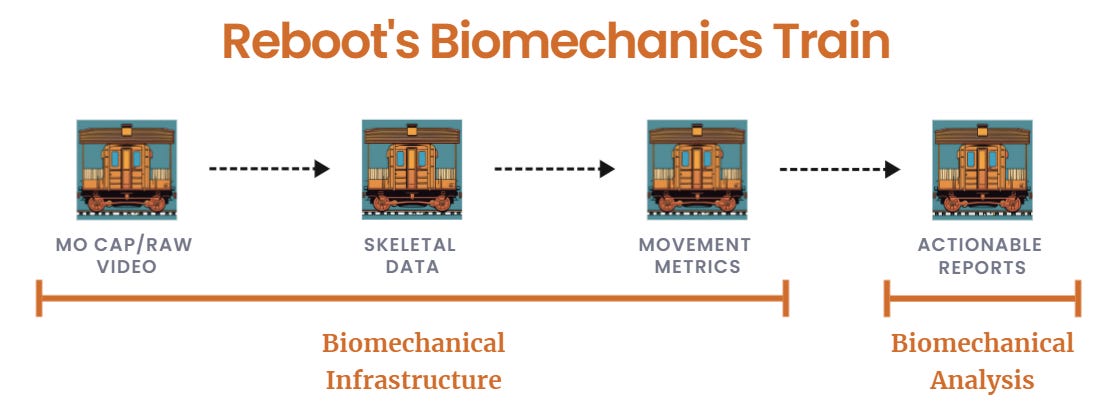
Our partners get on the train by sending us motion capture data or raw video. Depending on the use case, they get off at any of the next three stops with:
Biomechanists analyzing skeletal data to do further research,
Analysts using metrics to build better models, and
Coaches taking reports to the field or the court.
The place we feel AI has impacted Reboot Motion the most is in how computer vision (a subset of machine learning, which is a subset of AI) has made it easier to get on the train.
It is not hyperbole to say that AI has fueled the biomechanics boom. The reason every MLB organization can analyze every pitch and every swing from every game starts with their ability to get motion capture data from cameras installed in major and minor league parks throughout pro baseball.
And the reason NBA teams are curious how the lessons learned in baseball can be transferred over is, for the first time, the same data will be available to them.
Without machine learning, without computers being able to track 29 key points on an athlete’s body as they move, it would be much harder for pro teams to get on the biomechanics train.
AI is Not the Conductor
Although AI has fueled the biomechanics boom, we don’t think it should drive the train.
AI models are great at combing through mountains of data points and delivering correlations between a set of inputs and an output we care about (fastball velocity, shooting percentage, etc.).
Where it struggles, however, is explaining the why or the how.
This is why, as we transform motion capture data into skeletal data and actionable metrics, we write the equations ourselves, analyzing energy and momentum transfer from first principles.
Even if AI models can offer a reasonable answer, they can’t build trust with the front office or the coach.
And trust is huge when we’re talking about player development, player acquisition, and other seven and eight figure decisions.
Predictions for the Future
I am smart enough to know I am not smart enough to predict how AI technology will advance, or how use cases will evolve.
However, I do know:
Computer vision will continue to improve. Data quality from live games is not yet on par with what researchers are used to in a lab. But that gap is way smaller today than it was 5 years ago, and it would be crazy to not think the trend will continue.
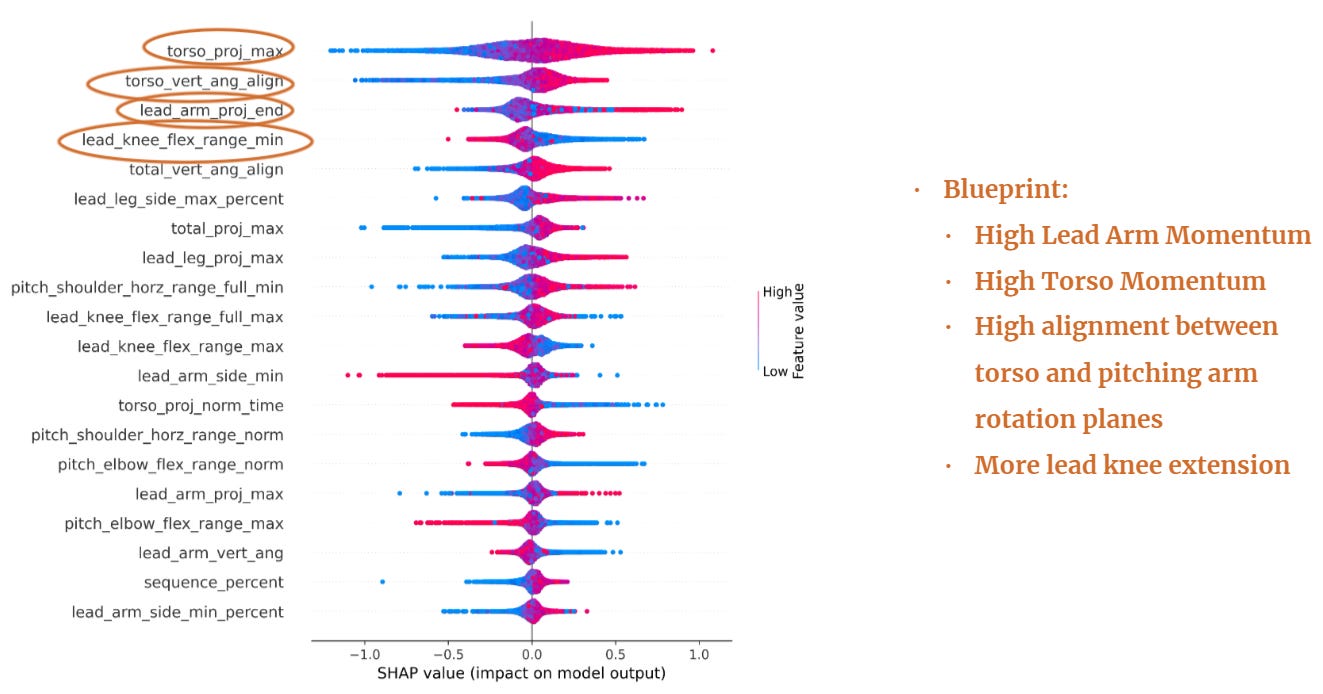
AI will help us augment our core biomechanics pipeline beyond computer vision. We already have examples today, with us using Shapley values to build a Blueprint for Safe Velocity.
Tomorrow, we expect to do even more, asking questions like:
Can we further drive down the “language barrier” between analysts and coaches?
Can we make it easier for coaches to build their own development plans based on 1) biomechanical data and 2) their specific coaching philosophy?
Can we deliver the same feedback pros receive today to college and high school athletes?

The likely answer to all of these is yes.
But, as exciting as AI technology is, it is important to remember what Michael Lewis warned us about in Moneyball:
“The numbers start out as tools for thinking. They wind up replacing thought.”
So, while we are happy letting machine learning make it easier to buy tickets to get onto the biomechanics train…
And we’re thrilled to use AI to add amenities to the final destination…
We can’t let AI be the conductor.
Biomechanists and engineers must drive the train, so we can put front offices and coaches first, empowering them to put their athletes first.